Showing posts with label history. Show all posts

Tuesday, September 17, 2013

Pearl Harbor: awaken the giant

HISTORY

Pearl HarborFor a civil man , it is often difficult to understand the rationale of military strategy . To an ignorant on the subject as who writes , makes absolutely no sense the act in Japan during the Pearl Harbor attack . Except ... unless the official historical facts are hiding part of the story . Perhaps the Japanese already knew it was imminent entry of the United States into the war and its action was defensive , seeking to delay the American attack . Or maybe they were just crazy ... Again, apologize for my ignorance .

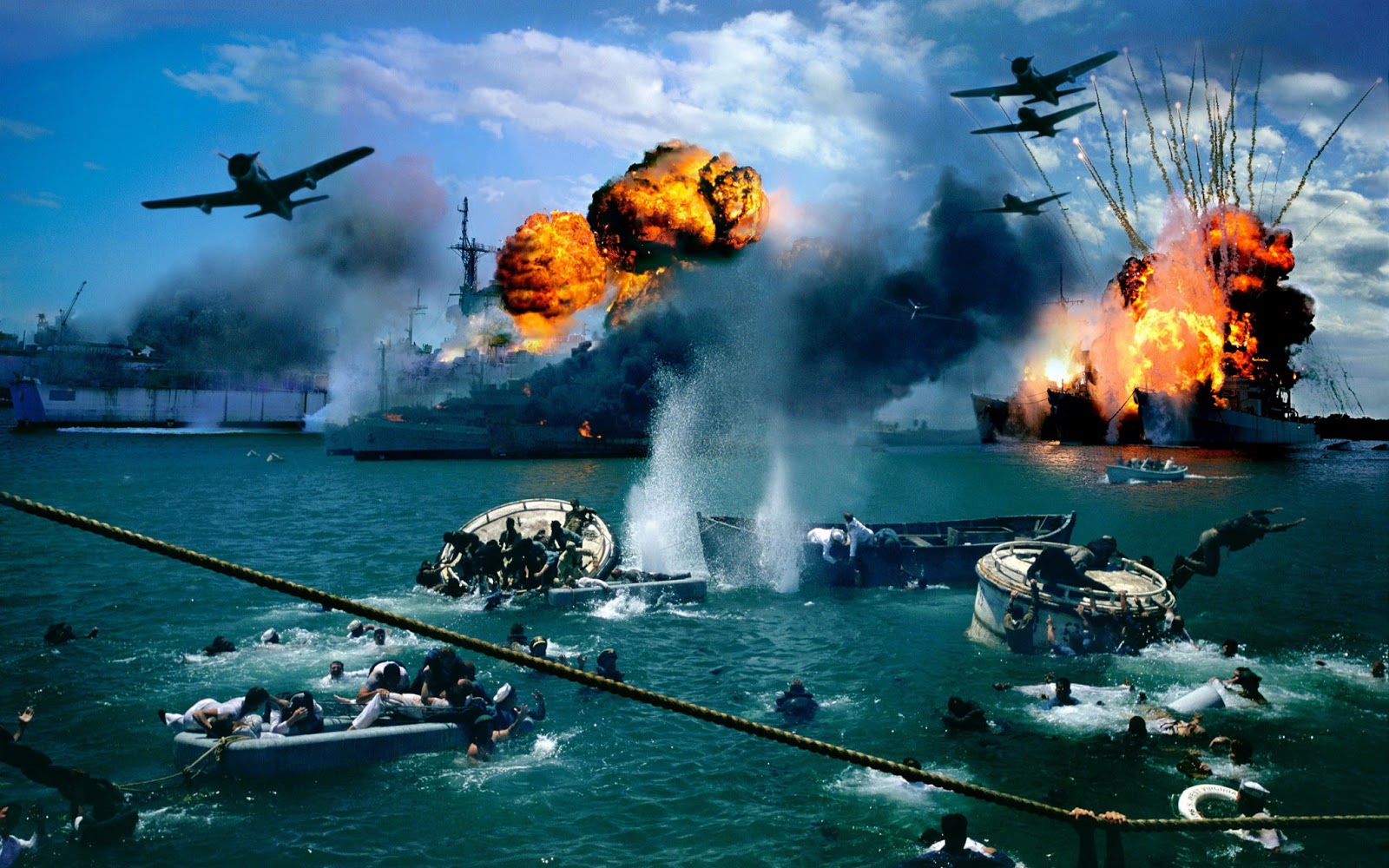
Pearl HarborThe attack on Pearl Harbor was a surprise military offensive conducted by the Imperial Japanese Navy against the naval base of the United States at Pearl Harbor , Hawaii, on the morning of December 7, 1941 . The attack was intended as a preventive action taken to eliminate the intervention of the Pacific Fleet of the United States military actions the Empire of Japan was planning in Southeast Asia perform against overseas territories of the United Kingdom, the Netherlands and the United States itself (or at least that's the official story ) .

Pearl HarborThe naval base was attacked by more than 300 Japanese aircraft including fighter jets , bombers and torpedo bombers that took off six portaaviones.Resultaron damaged eight U.S. battleships stationed in the port , and four of them were sunk . Of these eight , two were refloated and four repaired , so that six could re-enter service later in the war. The Japanese attack also sank or damaged three cruisers, three destroyers , one minelayer and training ship . The Americans lost 188 aircraft , killed 2402 Americans and 1282 were injured in varying degrees . However, the Japanese attacked the power station, shipyard , maintenance facilities , fuel tanks and torpedoes , submarine docks and the building of the headquarters and the intelligence section . The Japanese lost 29 aircraft and five midget submarines , as well as military casualties suffered 65 killed and wounded . Also, a Japanese sailor was captured alive .

Pearl Harbor
The attack deeply shocked American people and led directly to the U.S. entry into World War II in both theaters of war in Europe and the Pacific. The day after the attack , December 8 , the United States declared war on the Empire of Japan . Domestic support in North America to non- intervention in the global conflict , which had been strong , disappeared while clandestine assistance to the UK was replaced by a full alliance . Subsequent operations led the American nation that declared war Nazi Germany and Fascist Italy on December 11 , which was reciprocated by the U.S. the next day.

There are numerous historical precedents for military attack without a declaration of war by Japan . However, the absence of a formal declaration by the Japanese while negotiations were taking place that seemed to prosper led President Franklin D. Roosevelt to qualify for the December 7, 1941 as "a date which will live in infamy ."

Thursday, August 15, 2013

Battle of the Alamo: until the last drops dead

HISTORY
In every conflict there is an event that functions as a turning point. It may not be the one that determines the final result, but one that modifies the statuo quo, and causes an abrupt change enough to alter the winner. A large contingent of Mexican army besieged for 13 days Texian resistance in a building that would become famous over time: the Alamo. I can not encourage me to judge any of the two sides, as each sought to defend what he considered his own, but without doubt, the Alamo is held up as a symbol of the resistance of a group of brave men who chose to die but not leave their cause.
The Battle of the Alamo was a military conflict crucial in the Texas Revolution which consisted of a siege of 13 days, since its inception on February 23 until the final assault of March 6, 1836, and faced the army of Mexico , led by President Antonio Lopez de Santa Anna, against a secessionist militia Texans, mostly American settlers (naturalized Mexican) in San Antonio de Bexar in Mexican province of Coahuila and Texas. All belligerents in favor of the Republic of Texas were killed, except for two people, which inspired many settlers and adventurers Texans-Americans-to join the army of Texas, desirous of revenge, from the cruelty shown by Santa Anna during the siege, the Texans defeated the Mexican Army at the Battle of San Jacinto, on April 21, 1836, ending the revolutionary movement.
Several months prior, Texians had taken all federal troops out of the Coahuila and Texas, approximately 100
Texans then garrisoned at the Alamo. The Texian force grew slightly with the arrival of reinforcements led eventually by the co-commanders James Bowie and William Barret Travis. On February 23, approximately 1500 Mexican soldiers marched into San Antonio de Bexar, site currently sits San Antonio, as the first step in a campaign to retake Texas. For the next 12 days, the two armies were involved in several skirmishes with minimal casualties. Aware that his garrison could not withstand the attack of such a large force, Travis wrote several letters asking for more men and supplies, but only 100 reinforcements arrived.
On the morning of March 6, the Mexican Army advanced on the Alamo, after rejecting two attacks, Texians were unable to fend off a third. Because Mexican soldiers scaled the walls, most Texans soldiers fled to the interior buildings. Defenders unable to reach these points were slain by the Mexican cavalry as they attempt to escape. It is likely that a small group of Texans (five to seven of them) had been surrendered; yet these were executed instantly. Most eyewitness accounts reported from between 182 and 257 Texians dead, while most historians of the Alamo agree that there were between 400 and 600 Mexican soldiers wounded or killed in combat. In the end, many noncombatants were sent to Gonzales to spread the word of the Texian defeat. The news sparked panic and the Texian forces-settlers-most of the new Republic of Texas fled from the advancing Mexican army.

In the nineteenth century, in Texas, the Alamo complex gradually became know as the place of battle. The Texas Legislature purchased the land and buildings in the early part of the twentieth century and designated the Alamo chapel as Texas State Shrine. The Alamo is now the most popular tourist site in Texas. It has also
been the subject of numerous non-fiction works from 1843.

Thursday, July 11, 2013

Legionaries: Discipline as the key to success

HISTORY
A great empire is forged from great minds, both political and scientific. However, what sustains it, and will always be, a powerful and feared army. More is not always better, and the Romans showed it. Discipline, loyalty and courage allowed them for more than 10 centuries to protect their beloved empire from foreign invasions. The legionaries, one of the most memorable military bodies of human history.
The legionary was a heavy infantryman member of a military unit of the Roman army, formed usually by Roman citizens over 15 years.
The legionary was usually armed with two javelins, a sword (gladius), and up to the time of Tiberius, a dagger. For your protection wore a helmet, armor rings, plates or rectangular scales and a shield bearing a
metal shield or umbo to the hand position. Completed their equipment a pair of sandals and a backpack or bag.
One of its main attributes, since often faced with larger and better equipped armies, was to be part of a highly disciplined body in constant training, both to military maneuvers precisely and accurately.
The length of military service was a legionnaire in early Republic of the duration of the campaign. In the second century. C. service was established that the maximum should be 16 campaigns. After the reforms of Marius, the service time was set at 25 years, who were reduced to 20 in the time of Augustus. Received a pay for
your services, call stipendium from Furio Camillo reforms in the fourth century. C., at the end of their employment, as of Gaius Marius reforms expected to receive a plot of land, which conditioned life seriously end of the Roman Republic
They left their legacy to a different member military corps in history. For example, the French Foreign Legion, the Legion Legion Spanish and Polish.


Wednesday, June 26, 2013

Honourable East India Company: Take control of Asia

HISTORY
During a time whoever controlled the seas dominated trade and politics, at least in the colonial
territories. Golden Age of sailors (and pirates?) English, took to conquer the route linking the riches of the East with the insatiable demand of the old continent. However, this was not a company anyone incumbency had political, economic and even military for over 200 years. The Honourable East India Company was undoubtedly the star of world colonial history.
The Honourable East India Company was a society of investors who won the December 31, 1600 Royal Charter by Queen Elizabeth I of England with the intention of guaranteeing trade privileges in India . The royal charter gave the new company the artificial monopoly of all trade in the East Indies.
The first point of trade in India was established in the port of Surat in
1608. The next two years, the Company built its first factory in Machilipatnam, in the Bay of Bengal. Traders were often involved in confrontations with the Dutch and Portuguese who were in the Indian Ocean area. However, the company soon eclipsed the Portuguese who had established bases in Goa and Bombay (which was later ceded to the British). In 1647, the British company had 23 factories and 90 employees in India. In 1634, the Mughal emperor extended his hospitality and allowed the British trade in the Bengal region.
The company's business is focused on cotton, silk, indigo and tea. Also initiated some inroads in the business of spices, hitherto monopolized by the Dutch. A mid-nineteenth century, the control of the Company spread across most of India, Burma, Singapore and Hong Kong, a fifth of the world's population was under his authority.


Friday, May 31, 2013

Paraguay War: The destruction of a rising nation

HISTORY
There was once organized a South American nation where corruption did not govern. A country that was not only a supplier of raw material for the old world, but had reached a certain degree of industrialization and development. Paraguay was a nation to imitate, however his kind neighbors and much further stakeholders held a different view and set your goal in your destruction. Not claim that Paraguay would not have looked, but certainly the Paraguay War was a devastating conflict and
uneven, which largely determine the future of the Guarani people.
The War of Paraguay, called by the Paraguayans Great War was the military conflict in which the Triple Alliance (a coalition of Brazil, Uruguay and Argentina) fought militarily against Paraguay.
The conflict erupted in late 1864, when Marshal Francisco Solano López, president of Paraguay, decided to come to the aid of the government by the Partido Blanco of Uruguay, in civil war against the Colorado Party, he supported militarily by Brazil. Lopez warned governments of Brazil and Argentina would consider any aggression to Uruguay as an attack balance Plata States. The Brazilian government defied the threat and consequently the Paraguayan government seized the Brazilian merchant ship "Marquis of Olinda" in the port of Asuncion and imprisoned the governor of the Brazilian province of Mato Grosso, who was on board.
The first stage of the war was to the successful invasion of Mato Grosso by Paraguayan forces in December 1864 where he took and sacked the city of Corumbá and took possession of the province and its diamond mines. Then Mitre order refused permission to send troops Paraguay Argentine territory. In response, Paraguayan troops occupied the city of Corrientes, in April 1865, which forced Argentina to enter the war, allied with Brazil.
The war funding was obtained through borrowing in British firms, who saw the conflict against Paraguay
convenient. This was one of the few countries that had not fallen under his tutelage cheaper thanks to protectionism that had led to Paraguay to autonomous economic development trend and industrialist, in contrast to other South American states.

Wednesday, April 17, 2013

Manhattan Project: Planning the destruction of the human race

HISTORY

There is no worse fate for the human effort that creating weapons. Is it logical case that thousands of
men, companies, governments and scientists pool forces to plan, prepare, recruit and deploy the annihilation of millions of people? Obviously enough proportion of people thought so. Millions of dollars and over two years of work focused on killing as many people as quickly as possible. The Manhattan Project, another mistake of the human species.
 
The Manhattan Project was the code name for a science project conducted during World War II by the United States with partial support from the UK and Canada. The ultimate goal of the project was the development of the first atomic bomb before Nazi Germany got it. The scientific research was directed by physicist Julius Robert Oppenheimer while security and military operations were the responsibility of General Leslie Richard Groves. The project was carried out in numerous research centers being the most important of them the Manhattan Engineering District located in the place now known as Los Alamos National Laboratory.

The project brought together a large number of eminent scientists (physics, chemistry, computer science). Since, after testing in Germany before the war, it was known that atomic fission was possible and that the Nazis were already working on its own nuclear program met several brilliant minds who were also pacifists and leftists mostly. Many Jewish exiles, made ​​common cause in the struggle against fascism contributing their bit to the cause: get the bomb before the Germans. The first successful nuclear test occurred in the desert of Alamogordo, New Mexico.


IMAGES OF HIROSHIMA BEFORE (photo left) and AFTER EXPLOSION (right)


Monday, April 15, 2013

World War I: Power struggles in Europe

HISTORY

There is perhaps a more inefficient solution to a dispute that a war? European center of culture and development, land of philosophers. But fools ruled by ambition and pride inexhaustible unalterable,
succumbed in the worst delivery decisions million of his men to die in a war where everyone lost. At least the human race learned his lesson ... or not?  

The First World War or Great War was an armed conflict that took place between 1914 and 1918 and produced more than 10 million casualties. Over 60 million European soldiers were mobilized from 1914 to 1918.Originado in Europe by the rivalry between the imperialist powers, became the first military conflict to cover more than half the planet. Was once the bloodiest in history. Before the Second World War, this war used to be called the Great War or War of Wars. War was the most damaging in history after the Second World War

The war began as a conflict between Austria-Hungary and Serbia for the assassination of the heir to the Austro-Hungarian throne (Author's note: at least that's the official version). Russia joined the conflict, it was considered the protector of the Slavic countries and wished to undermine the position of Austria-Hungary in the Balkans. Germany responded to the war with Russia, bound by a confidentiality agreement entered into with the Habsburg monarchy, and France moved to support its ally.